RPGaDay2020 - Days 2–4
Once again, I am behind on this year's #RPGaDay posts... It's been a busy few days in the store (well, through to Monday—yesterday was dead due to the weather, but I got a lot of other work sorted out), so I've not been able to post each day as I wanted. However, I'm on my day off, so I might as well roll those posts into one!
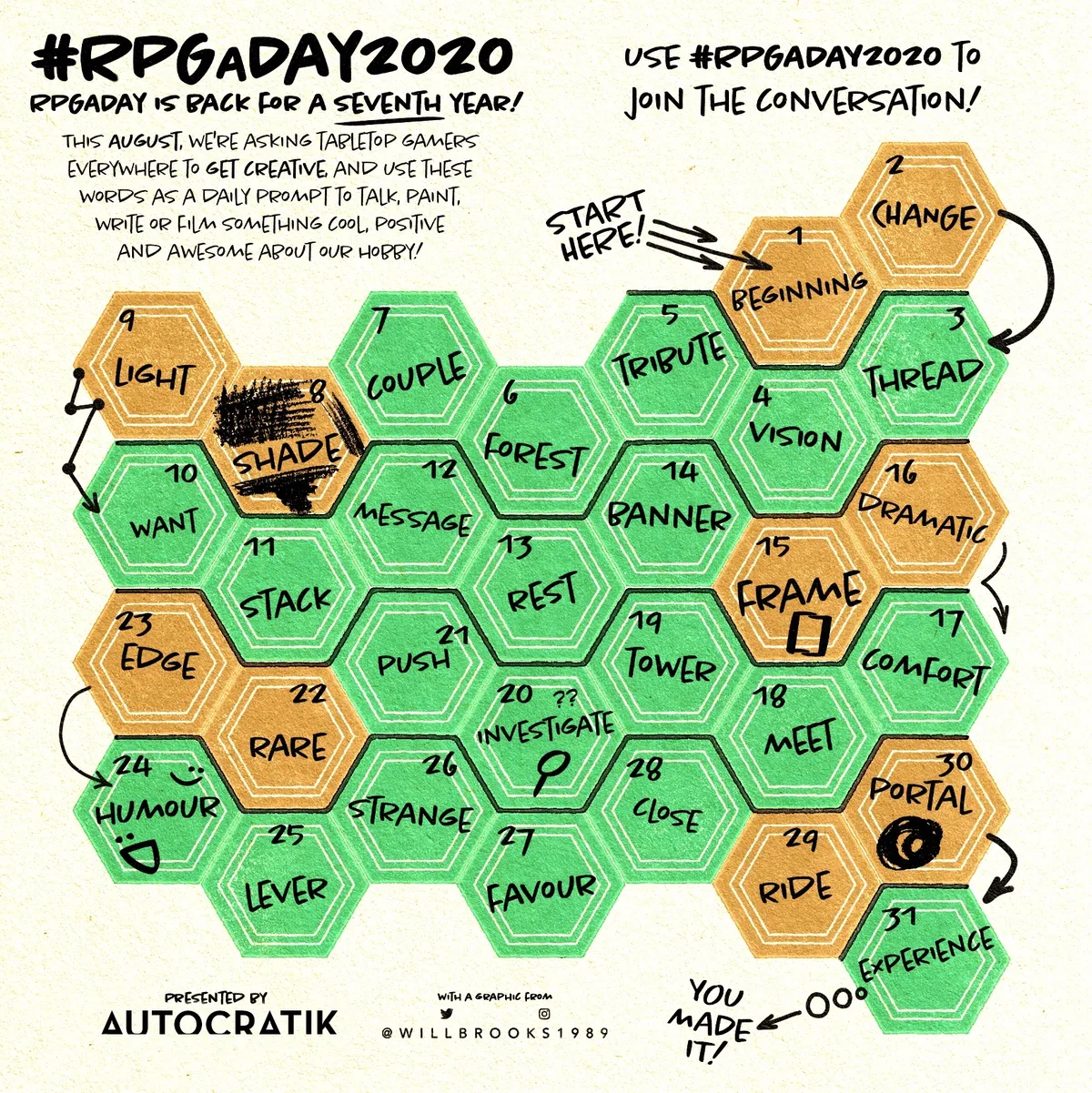
Day 2: Change
The last 12 months has seen a great deal of change for me personally. Last July I was a bit of a wreck, coming out of a job that had mentally crushed me; one where I would be physically and emotionally drained at the end of the day, and which caused a great deal of anxiety and depression. On the advice of doctors and through the support of my wife I sought help and overcame that hump, though anxiety and depression still haunt me at times. Previously, I'd enjoyed writing RPG materials and had (intermittently) blogged about them. Now, while I still played regularly, seeing RPGs as a relief from day to day ordeals, my writing suffered. It hasn't been until recently that I've thrown myself back into writing, achieving my first self publication with Ominous Crypt.
I wrote Ominous Crypt during the time that I was furloughed in the middle of the coronavirus lock down in the UK. While the enforced closures of business—the game store I run included—and the wave of deaths and handling of the situation by governments was a source of anxiety (what happens if I catch it? what if the business if forced to close? why aren't those in power quicker to react?), I decided to focus on working through a backlog of unfinished projects, ranging from war games terrain to reading RPG books and writing. I guess it was to distract myself from the world at large. I am thankful I did. Now my head is swimming with ideas. I only hope I can hold onto them and turn them into something creative. The motivation is there and I hope to see the change where I can continue to write RPG materials even as I return to work and live slowly returns back to normal. Will I regress back to before, whiling away hours in the store by day and coming home to watch nothing by streamed TV shows and late nights; or will I cast off the shackles that social media and constant connectedness have bound me with and encourage my creativity to flourish. Only time will tell...
Day 3: Thread
I'm not entirely sure how to interpret today's keyword, but I'm going to focus on one particular thing, which is a thread on gaming site boardgamegeek.com. That thread is known as the Feel The Love (or FTL) thread. I guess it started off as a love bombing message thread (almost cult like in its activities?—sorry, I've been playing too much Delta Green) that drew attention and users from across the site to send each other messages of encouragement and congratulations for achievements and other events both in gaming and real life. It was a fantastic community to be a part of and one that exponentially grew. Eventually, it surpassed the ability of BGG's servers to load the thread without major issues and the threads are now locked after a certain number of posts have been achieved and a new thread is started. They are now on thread number 9 and Feel the Love even has it's own community section on the site.
However, the constant messages did become hard to keep up with and it was difficult to stay connected with the people that you felt more of a friendship with when so many were joining and posting day after day. Eventually, I dropped out of the threads, but I have stayed in touch with some of the original founders of the FTL thread in a guild sub-thread, which is a much quieter and slower paced setting.
The reason I bring this thread up today is because if it wasn't for it, I wouldn't have the rich roleplaying experiences that I enjoy the a weekly basis that I do today. That's because it was FTL member Narl (aka Leonie) who asked me to join in as a fifth member for an online Fiasco game one day. That turned into a regular Fiasco game a couple of times a month, then regular games every week, allowing me to play multiple systems, such as Blades in the Dark, Star Trek Adventures, Forbidden Lands and so on, which I just wouldn't have been able to try in my face-to-face games. Currently, I am playing in a biweekly Vampire the Requiem game and a weekly Shadows of Esteren campaign with my good friends Kai, Fred, Michael and Leonie (who has pretty much been a part of my online RPGing since I started). We have an amazing GM in Kai, who is a master at storytelling and adventure crafting. I am very thankful that I found the FTL thread many years ago for this reason and, while I don't engage much with it currently, it will always have a place in my heart.
Day 4: Vision
Vision is a hard one, but I am going to talk about two things. My vision for how I run my games and my vision for my RPG writing.
My gaming philosophy has changed quite a lot of the years. I started playing RPGs with D&D and my games were your standard dungeon crawling affairs, though I did a lot of world building, often influenced by TV shows and video games, that never really saw the light of day. I remember one world being a techno-fantasy spawned from my love of JRPGs like Final Fantasy 7—a mishmash of the usual fantasy tropes and high-tech airships and laser weapons. Storytelling in games wasn't something I came across until I discovered Vampire The Masquerade in my teens. I was probably influenced by an advert in Dragon Magazine or similar (god, I miss such publications—there isn't anything like them today!). However, coming from an F20 background, making the leap to them was hard.
When I came back to RPGs in my late 20s after a roughly 10 year hiatus, it was the more traditional games that I started with again—D&D, World of Darkness, Call of Cthulhu. But I started to discover more story focused games too. Games like Trail of Cthulhu, with its Gumshoe system that eschews most dice rolls for spending points, allowed me to explore story elements deeply, whereas Call of Cthulhu's rules seemed to push more towards the F20 themes (I now realise this to be a fallacy and CoC is now one of my most played and most story orientated gaming experiences). Systems like FATE I found hard to parse at first, but as I got to grips with Powered by the Apocalypse and Forged in the Dark, I began to see the benefits of story and the varied approaches to its emergence in play.
My vision of how to approach session and campaign design changed in response. Whereas before I often had a rigid idea of how a story was supposed to go, pouring significant lengths of time into preparing for sessions, I now spend little (if any!) time in preparation. Admittedly, I do use a lot of published material to run games from, as life often gets in the way and leaves little time to think about campaigns and such, but more often than not use these as mere guidelines to run from. Two of my favourite campaigns that I am running at the moment are for D&D and the entirety of the plot emerges from play (despite one of these being loosely hung around Tomb of Annihilation) using inspiration from what the player's want to see in their world.
Story emerging from play is also part of my vision for my own writing. This is somewhat easier to do with the old-school D&D games I write, where story emerges from the players interaction with the environments that they explore—where their engagement with the world around them is the story. I try to include random elements into my writing, something which is a cornerstone of the OSR style game, so that GMs can develop things on the fly. Stories in these worlds don't feel as rigidly set in stone and that is something that I like and encourage.
However, this is something harder to do with scenarios for Call of Cthulhu. My first few attempts to write CoC adventures were often mired in the more traditional "kill the monster" tropes of the F20 scene and I didn't enjoy that. It doesn't make for a good story, even if investigators will no doubt we dealing with the monsters one way or another at the end. It was Graham Walmsley's Final Revelation arc of adventures and his wonderful book Stealing Cthulhu that really opened my eyes to what you can do with Call of Cthulhu adventures. If you haven't read these books, I highly recommend that you do. Now, I try to follow this line of thinking when writing for this style of scenario. More so, I like to place humans at the centre of such stories. I like to present moral quandaries to my investigators and in doing so make sure that my villains are never purely villainous. The Mythos is the villain, everyone else is just swept up by it. I hope that this is something that comes through in both Keepers of the Woods and Those Within, and will continue to develop in future projects too...
That's all for now—hopefully I'll get something written for Day 5 (today...) later on. Plus, I am looking forward to Day 6's post, when I'll be sharing something from Maqsum: The Shattered Lands, which I am hoping to bring forth as part of a zine-based publication covering this weird fantasy setting for old-school games.